
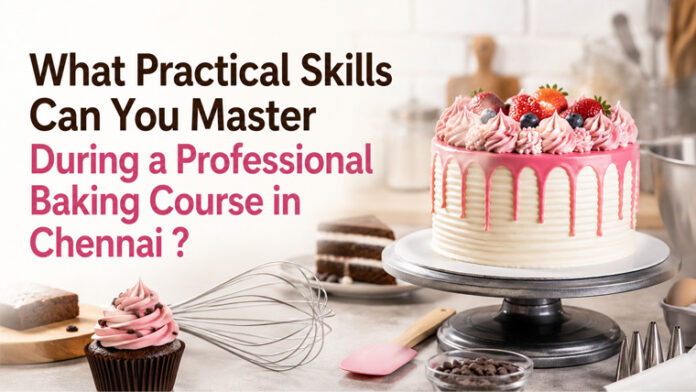


Picture someone standing in their kitchen at 11 pm, staring at a cake that collapsed in the middle again. They followed the recipe. They measured everything. And yet the sponge sank, the icing slid off, and the whole thing looks nothing like the picture they saved months ago. This is the point where a lot of home bakers in Chennai start asking a different question. Not “which recipe should I try next,” but “what am I actually missing?” That gap between following instructions and understanding why they work is exactly what a Professional Bakery Courses In Chennai is built to close. Over a structured programme, learners typically move through ingredient science, dough and batter handling, bread fermentation, laminated pastry, cake construction and decoration, plating and presentation, and the everyday hygiene and costing habits that separate a hobby from a working kitchen. None of these are flashy add-ons. Each one solves a specific, repeatable problem that shows up the moment someone tries to bake at a professional level. The sections below walk through what each skill actually involves and why it matters more than most new bakers expect.
Understanding Ingredients Before Touching a Recipe
Most home bakers treat flour, sugar, and fat as interchangeable building blocks. A course changes that early. Learners spend real time on why bread flour behaves differently from cake flour, what fat does to gluten development, and how sugar affects browning and moisture retention. This sounds academic until someone bakes the same recipe twice with two different flours and gets two different textures. Once that connection clicks, recipe troubleshooting stops feeling like guesswork.
Mixing Methods and Why They’re Never Interchangeable
There’s a reason recipes specify creaming, folding, or the rubbing-in method rather than just saying “mix everything.” Each technique controls how much air gets trapped, how gluten forms, and how the final crumb turns out. A student who has folded egg whites into a batter by hand, watched it deflate from overmixing, and then done it right the second time understands this in a way no written explanation can replicate. This is one of those skills that looks small on paper but quietly fixes half the common baking failures people run into at home.
Bread Fundamentals: Fermentation, Shaping, and Timing
Bread is unforgiving in a way cakes aren’t. Get the fermentation time wrong and the loaf is either dense or over-proofed and collapsing. This is where a structured course earns its place, because timing and dough feel are almost impossible to learn from a video alone. Students work with yeast behaviour, hydration levels, and shaping techniques repeatedly until their hands start recognising when dough is actually ready, rather than relying only on a clock.
Laminated Pastry and Precision Work
Croissants, puff pastry, and Danish dough ask for a different kind of patience. Temperature control becomes non-negotiable here; butter that’s too warm melts into the dough instead of staying in distinct layers, and the result is flat and greasy rather than flaky. Learning to laminate dough properly teaches something that carries over into other areas of baking too: respect for temperature as an ingredient in its own right, not just a background condition.
Cake Construction, Filling, and Decoration
Baking a sponge is one skill. Building a stable, evenly layered cake that holds its shape under fondant or buttercream is another entirely. This section of a course usually covers levelling, filling ratios, crumb coating, and basic piping, along with the more practical question of how to transport a finished cake without disaster. It’s worth acknowledging that many students find this the most intimidating part, mostly because decoration feels artistic and therefore subjective. In practice, most decoration failures come down to a handful of fixable technical issues: buttercream consistency, temperature, and layering order, not a lack of natural talent.
Plating, Presentation, and Reading a Dessert Visually
Professional kitchens judge desserts on presentation almost as much as taste, and this is an area home bakers rarely think about until they’re asked to plate something for a client or an event. Balance, colour contrast, and portion sizing are taught as deliberate choices rather than instinct. It changes how a student looks at their own work afterward, because they start noticing what’s missing on a plate rather than just whether it tastes good.
Hygiene, Costing, and the Business Side Nobody Talks About
This is the part that surprises people who signed up purely for the creative side. Food safety practices, ingredient costing, portion control, and basic pricing math are usually part of any serious programme, because a baker who can’t calculate the real cost of a batch will struggle the moment they try to sell their work. It isn’t glamorous, but it’s often the difference between a hobby that stays a hobby and one that turns into something sustainable.
Taken together, these skills explain why that collapsed midnight cake happens in the first place, and more importantly, why it stops happening once someone understands ingredient behaviour, mixing method, and timing as connected pieces rather than isolated steps. Anyone researching Baking Classes In Chennai Velachery, including programmes run by institutes like Zeroin Academy, is usually looking for exactly this kind of structured, hands-on progression rather than another recipe to follow blindly. The goal was never to memorise more recipes. It was to understand the reasoning behind them, which is what actually stops a cake from sinking the next time around.